
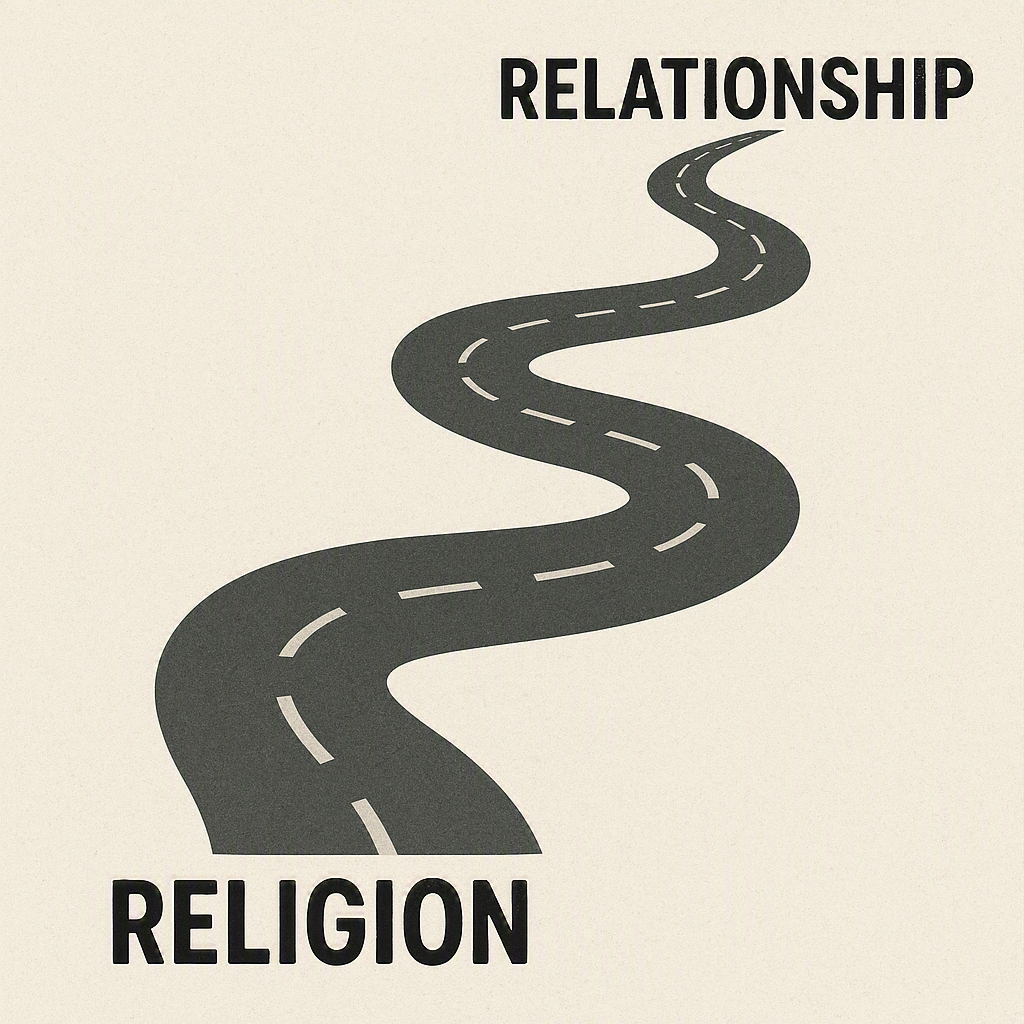
More recently, I have been beating the proverbial drum about relationship over religion. I realize it can be difficult to understand and embrace this concept, and all too often, the discussion can appear critical, condemning, and uncompassionate toward those in religion. So, I want to say something important: this is not a criticism of Catholics or an attempt to convince anyone that they are wrong and need to convert. I grew up in the Catholic Church, and I know many Catholics who genuinely love God and seek to honor Him. This is simply my story, my experience. It is how I personally journeyed away from religion and into relationship. It summarizes some of the biblical truths that transformed my understanding of God, Jesus, and Holy Spirit.
For much of my life (46 years), I knew about Jesus. I attended church, participated in the sacraments, and did my best to be a good person, but I grew away from religion the older I got. There are many reasons for this, but it comes down to one simple fact: I felt there was always something missing from my life. I knew there had to be more than what I saw in religion, but I didn’t know what that was. I didn’t know there was this “thing” called “relationship.” Looking back, I realize I had information about God, but I did not yet understand what it meant to truly know Him and be fully known by Him.
When I encountered the Gospel through the lens of scripture and entered into a personal relationship with Jesus, several things became clear to me.
Baptism Is a Declaration of Faith, Not the Source of Salvation
Growing up, I was taught and therefore viewed baptism as closely connected to salvation itself. I believed I was saved because I had been baptized. As I began studying Scripture, I came to understand baptism as an outward expression of an inward transformation.
Baptism is a beautiful act of obedience that publicly declares our faith in Jesus Christ. It symbolizes our identification with His death, burial, and resurrection (Romans 6:3-4). However, salvation comes through faith in Christ, not through any ceremony or ritual.
The thief on the cross was never baptized, yet Jesus assured him, “Today you will be with me in paradise” (Luke 23:43). He was saved for placing his faith in Jesus in that desperate moment.
We Are Saved by Grace Through Faith, Not by Good Works
One of the most freeing truths I discovered was that I could never earn God’s love or salvation.
Ephesians 2:8-9 says, “For by grace you have been saved through faith. And this is not your own doing; it is the gift of God, not a result of works, so that no one may boast.”
Good works matter. We are created in Christ for them (Ephesians 2:10). Good works are evidence of a transformed life. But they are the fruit of salvation, not the root of it. We obey God because we love Him, not because we are trying to earn His love, acceptance, or salvation.
We Worship a Living Savior
One of the most profound shifts in my faith was learning to focus not only on Christ’s sacrifice but also on His victory. This became clearer as I noticed how evangelical churches display an empty cross as opposed to a cross with the crucified Jesus hanging on it.
Yes, Jesus died for our sins, and His sacrifice on the cross is central to our faith. But He did not remain there. He rose from the grave, defeated sin and death, and now sits at the right hand of the Father. The resurrection changed everything, and the message of an empty cross celebrates that.
My faith became less about remembering a tragic event and more about celebrating a living, risen Savior who is active, present, and reigning today.
We Pray Directly to the Father Through Jesus
As I studied Scripture, I noticed a consistent pattern: Jesus and believers prayed directly to God.
Jesus taught His disciples to pray, “Our Father in heaven” (Matthew 6:9). He also declared, “I am the way, and the truth, and the life. No one comes to the Father except through me” (John 14:6).
Because of Christ’s finished work, we have direct access to God. We can boldly approach His throne of grace (Hebrews 4:16), bringing our sin, needs, fears, hopes, and prayers directly to Him. We don’t require an intermediary via a priest, the saints, or Mary.
This realization transformed my prayer life. God no longer felt distant. He became personal, accessible, and near.
Jesus Is Our High Priest and Intercessor
Scripture teaches that Jesus Himself serves as our High Priest. Hebrews 7:25 tells us that He “always lives to make intercession” for us.
Because of what Jesus accomplished, we no longer need a human mediator between ourselves and God. Christ stands in that role perfectly and eternally.
This truth gave me tremendous confidence because my relationship with God no longer depended on me or another person. It depended on Jesus and Jesus alone.
Church Became More Than Ritual
I am grateful for many traditions that point people toward God. However, I discovered that church was never intended to be merely a series of rituals, routines, or religious obligations. (In fairness, even the evangelical Church is mostly this way, too. Every Sunday is predictable and primarily remains within a safe and reliable pattern of worship, tithe talk, sermon, prayer, dismissal.)
That said, there are distinct differences between a Catholic mass and an evangelical church service. So to me, church services became a gathering of believers worshipping the living God, studying His Word, encouraging one another, and growing together in faith.
The focus shifted from simply participating in religious practices to encountering the presence of God.
The Holy Spirit Became Real
Perhaps one of the greatest discoveries in my walk with Christ was understanding the role of the Holy Spirit.
Jesus promised that the Holy Spirit would teach, guide, comfort, and empower believers (John 14:26). I learned that Holy Spirit is not merely a doctrine to affirm but a Person to know.
He convicts us, leads us into truth, equips us with spiritual gifts, and empowers us to live the Christian life. What once felt like a distant faith became a living relationship energized by knowing that God’s presence dwelt within me via Holy Spirit.
The Father Is Love
For many years, I viewed God primarily as a judge waiting for me to fail. Scripture revealed a different picture. The Father is holy and just, but He is also loving, compassionate, merciful, and kind. First John 4:8 simply says, “God is love.”
Jesus consistently revealed the heart of the Father. He welcomed sinners, healed the broken and sick, delivered the demonized, pursued the lost, and extended grace to those who knew they needed it. He also rebuked the religious leaders of the day for holding fast to their own traditions and rituals. That was love and the heart of the Father, too. Jesus came to demonstrate relationship and tear down religion.
I began to see God not as someone trying to keep me out, but as a loving Father inviting me in.
I Learned My Identity and Authority in Christ
The Bible teaches that believers are adopted as sons and daughters of God (Romans 8:15-17). This was revolutionary for me.
My identity was no longer rooted in my performance, failures, or religious achievements. It was rooted in what Jesus had already accomplished through His death and resurrection.
I discovered that I was loved, accepted, forgiven, chosen, and empowered. I also learned that believers have spiritual authority through Christ, not because of who we are, but because of whose we are.
Salvation Is the Beginning, Not the Destination
One of the most important lessons I learned is that Christianity is not simply about avoiding hell and getting to heaven. Jesus did not merely save us from something; He saved us for something.
He calls us into relationship with Himself and invites us to surrender every area of our lives to His Lordship. Salvation opens the door. Relationship is what happens when we walk through it.
Following Jesus became less about checking religious boxes and more about knowing Him, loving Him, obeying Him, and becoming more like Him.
Final Thoughts
My journey has taught me that Christianity is not fundamentally about religion. It is about relationship.
It is about a loving Father who sent His Son to rescue us.
It is about a risen Savior who conquered death and now lives forever.
It is about the Holy Spirit dwelling within believers and empowering them to live transformed lives.
Most of all, it is about knowing Him personally.
I share these reflections to testify to what Jesus has done in my life. I am grateful for every step of my journey, including my Catholic upbringing, because God used it as part of the path that ultimately led me to a deeper understanding of His grace, His love, and His invitation into relationship with Him.
Originally posted 20-Jun-26; edited 28-Jun-26 to add:
Final, Final Thoughts 🙂 – The Journey is Ongoing Pursuit
One of the greatest misconceptions I carried for years was thinking that becoming a Christian was primarily about securing my eternal destination.
While salvation is the greatest gift we could ever receive, Scripture shows that it is not the finish line. It is the starting line.
When we place our faith in Jesus, we are born again into God’s family. We become His child. From that moment forward, He invites us into a lifelong relationship with Him. Like any healthy relationship, it grows through time spent together. We learn His voice by reading His Word. We draw near to Him through prayer. We are shaped by the Holy Spirit as we surrender more of our lives to His Lordship.
Jesus never invited people to simply pray a prayer and move on with life. His invitation was, “Follow Me.” Period. Full stop. Every day in every way.
Following Jesus is an ongoing pursuit. There are seasons of growth, seasons of pruning, seasons of learning, and seasons where His grace carries us when we are weak. Throughout it all, He faithfully continues the work He began in us (Philippians 1:6).
I have discovered that Christianity is not a one-time transaction. It is a lifelong transformation. Salvation is received in a moment by grace through faith, but knowing Jesus is an adventure that lasts a lifetime. And it truly is an adventure!
The more I know Him, the more I realize there is still so much more to know. That is the beauty of relationship.

Leave a Reply